
Cervical cancer has almost no early symptoms, so it often progresses before a woman notices anything unusual. This column covers who is eligible for national cervical cancer screening and how often, what the terms on the result sheet mean, and when further tests are needed. In short, women aged 20 and over should have screening every 2 years, and because an abnormal finding does not immediately mean cancer, the next step is simply a repeat test or a more detailed examination that matches the grade of the result.
01
Who has national cervical cancer screening, and how often?
Key point
The national cervical cancer screening programme is for women aged 20 and over and is taken every 2 years. Women whose birth year ends in an odd number are eligible in odd-numbered years, and those with an even final digit in even-numbered years. Keeping to this schedule even without symptoms is the key point.
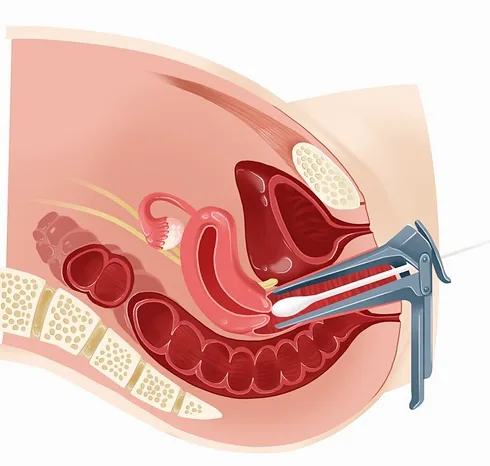
The eligible year for national cervical cancer screening is easy to work out from the last digit of the birth year. For example, women born in 1993, 1995 or 1997 are eligible in 2025 and are screened again in 2027. The cervical cancer test in the national programme is, strictly speaking, a cervical cytology test: a long swab is brushed lightly across the surface of the cervix, and the collected cells are checked for abnormal cells.
A cervical cytology test takes only about 1 to 2 minutes and is not a great burden. The 2-year interval is stressed repeatedly all the same, because cervical cancer responds better to treatment the earlier it is found, yet it has almost no early symptoms and is easily left unnoticed when no test is done.
02
Does an abnormal finding on the cell test mean cancer?
Key point
An abnormal finding on a cervical cell test does not in itself mean cancer. Results are grouped as normal, ASCUS, LSIL, HSIL or suspected cancer, and depending on the grade the next step is decided: a repeat test after 6 months, a biopsy, or follow-up observation or treatment.
Terms such as ASCUS, LSIL and HSIL on a cervical cytology result sheet are unfamiliar and can easily add to a patient's worry. However, an abnormal finding does not automatically lead to a diagnosis of cancer. Each term is closer to a marker that shows the degree of cell change and the next stage of testing that fits it.
HSIL, which means high-grade dysplasia, is classed as a precancerous stage just before cancer. Even so, the outlook is generally good when it is found at the precancerous stage and treated early, and this is what makes regular screening so clearly worthwhile. Not putting off the repeat test or biopsy that has been advised after the result is the practical way to stop progression to cervical cancer.
- ASCUS — the shape of the cells is slightly unusual; it sometimes clears up naturally, but a repeat test after 6 months is recommended
- LSIL — low-grade cervical dysplasia; after a biopsy, follow-up observation or treatment is decided according to the diagnosis
- HSIL — high-grade cervical dysplasia, classed as a precancerous stage; treatment is decided according to the biopsy result
03
Why are an HPV test and colposcopy needed in addition to the cell test?
Key point
A cell test examines only the cells on the surface of the cervix, so it has limits in picking up abnormal lesions. Depending on the patient's condition, an HPV test is used to check the risk of cancer developing in advance, and when there is an abnormal finding, colposcopy allows the cervix to be observed directly.
More than 90% of cervical cancers are caused by infection with human papillomavirus (HPV). Infection does not always lead to cancer, but with a high-risk type of the virus the likelihood of progression to cancer rises. For this reason an HPV test can be understood as a test that checks in advance how likely cancer is to develop.
Colposcopy is the stage that follows when an abnormal finding has been confirmed on a cell test or similar examination. The cervix is magnified and observed directly, and if necessary a small piece of tissue is removed for a biopsy on the spot, so it plays an important part in diagnosing cancer early. Because cervical cancer is a cancer whose causative virus has been identified, HPV vaccination can greatly lower its incidence, which is also worth discussing during a consultation.
- Cervical cytology test — the basic test, in which cells are collected from the surface of the cervix and checked for abnormal cells
- HPV test — checks for infection with human papillomavirus, the main cause of cervical cancer, to gauge the risk of cancer in advance
- Colposcopy — the cervix is magnified and observed directly, and if necessary a small piece of tissue is removed for a biopsy
Doctor's view
How the doctor decides
Seeun Cho, Medical Director · Obstetrics & Gynecology Specialist
I do not say everything is fine from a single cell test result
A cell test examines only the surface cells, so I do not conclude from a single result sheet that a patient can stop worrying. Depending on her condition, I first consider whether an HPV test or colposcopy is needed, and if something abnormal is seen I move straight on to the next test so that the diagnosis comes sooner. I do this so that a change which could have been confirmed is not missed while testing is delayed.
I set the management plan according to the grade of the result
Whether the result is ASCUS, LSIL or HSIL changes whether I repeat the test, take a biopsy, or choose between follow-up observation and treatment. Even when the findings look alike, I do not handle them all in the same way; I decide on management and treatment according to the test results.
I explain first why a test is needed
When the terms are unfamiliar, anxiety grows the moment a patient hears the result. So I explain fully why a further test is needed, what the present result means, and why I recommend vaccination, and only then do I decide the next step together with the patient.
Summary
In summary
Cervical cancer has almost no early symptoms and is hard to detect without testing, so the basic rule for women aged 20 and over is to have national screening every 2 years according to their birth year. An abnormal finding on the cell test does not immediately mean cancer; a repeat test or a more detailed examination that fits the grade of the result is the next step. If your eligible year has come round, if your result sheet shows an abnormal finding, or if you are considering HPV vaccination, a visit to a gynaecologist is a sensible next move.
FAQ
Frequently asked questions
Does a cervical cancer test hurt?
In a cervical cytology test, a long swab is brushed lightly across the surface of the cervix to collect cells, so pain and discomfort are generally mild. The test is over in about 1 to 2 minutes.
How can I tell whether I am eligible for screening this year?
If your birth year ends in an odd number you are eligible in odd-numbered years, and if it ends in an even number, in even-numbered years. A woman born in 1995 is eligible in 2025 and is screened again in 2027.
If the result is ASCUS, do I need treatment straight away?
ASCUS means the shape of the cells is slightly unusual, and in some cases it clears up naturally. A repeat test after 6 months is usually recommended, and a biopsy may be carried out depending on the medical team's judgement.