
Ovarian cancer is often called a 'silent cancer' because its early symptoms are not clear-cut. This column looks at the early symptoms and at survival rates by stage. When it is found at stage 1 the survival rate is 89%, but at stage 3 it falls to 36%.
That gap depends on how quickly unusual signs are noticed and checked. Below, the early symptoms, survival rates by stage and the tests that are needed are set out in turn.
01
Why is ovarian cancer so hard to find early?
Key point
Early symptoms of ovarian cancer closely resemble everyday complaints such as indigestion or irregular periods, which makes the disease hard to pin down. As a result, 60 to 70% of all patients are diagnosed only after it has already progressed to stage 3 or beyond.
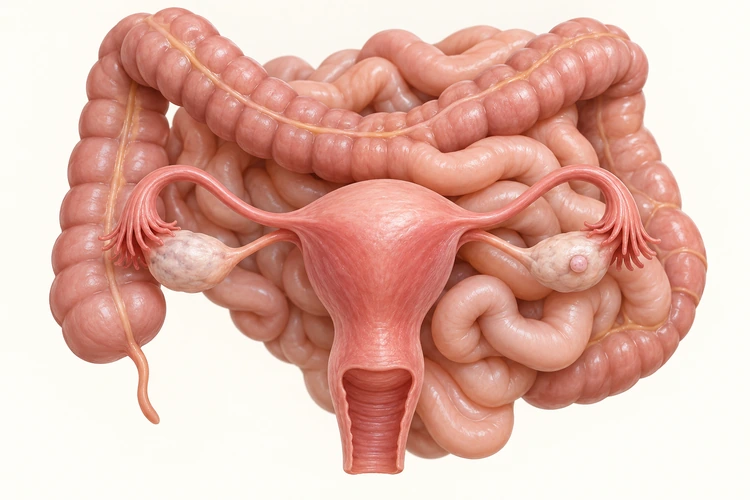
Ovarian cancer is a malignant tumour that develops in the ovaries, which release eggs and produce hormones, and among gynaecological cancers it is the most common after cervical cancer. Its early symptoms, such as heaviness in the lower abdomen or indigestion, resemble ordinary discomforts, so it is hard for women to read them as a clear warning sign.
About 2500 patients are newly diagnosed with ovarian cancer each year, and many of them only see a doctor once symptoms have become obvious, by which point the disease has already progressed. The figure that 60 to 70% of all patients are found at stage 3 or beyond reflects this.
02
What exactly are the early symptoms of ovarian cancer?
Key point
Early symptoms of ovarian cancer appear as changes from what is usual for you: heaviness in the lower abdomen, frequent urination, digestive trouble, and irregular periods or abnormal bleeding. Ovarian cancer should be considered when several of these symptoms overlap or keep coming back.
The signals the body sends while ovarian cancer progresses mostly look like digestive or urinary discomfort, which makes them easy to brush aside. If the lower abdomen feels heavy, or there seems to be a lump or cyst inside the abdomen, it is safer to have the cause checked by a gynaecologist than to assume it is simple indigestion.
As this is a cancer affecting women, changes related to periods or abnormal bleeding also deserve attention. If period pain has become worse than usual, or bleeding unrelated to the menstrual cycle keeps recurring, a check-up is warranted. When several symptoms overlap or last a long time, it is better not to put off testing.
- Heaviness in the lower abdomen — the lower belly feels heavy for no particular reason
- Frequent urination — you pass urine more often, with a feeling of pressure on the bladder
- A lump or cyst in the abdomen — a lump or cyst can be felt or is found on examination
- Digestive trouble — bloating or indigestion continues without an obvious cause
- Irregular periods or abnormal bleeding — period pain worsens or bleeding unrelated to the cycle keeps recurring
03
How much does the survival rate change depending on when ovarian cancer is found?
Key point
When it is found at stage 1, ovarian cancer has a survival rate of 89%, but this falls sharply to 36% at stage 3 and 17% at stage 4. Even so, only about 10% of all patients are diagnosed while the disease is still at stage 2 or earlier.
The survival rate of ovarian cancer differs enormously depending on when it is found. Diagnosed at stage 1, the survival rate is 89%, and found at stage 2 it still holds at 70%, but once the disease moves into stage 3 it drops to 36%. Compared with stage 2, that means only about 4 in 10 patients survive.
The fact that it is not unusual for the disease to be found only at stage 4 shows how many patients are diagnosed after it has progressed considerably. Since only a minority of patients are known to be diagnosed early, it is important not to dismiss early symptoms.
04
Which tests are needed if symptoms keep recurring?
Key point
If symptoms such as bloating or frequent urination recur almost every day for 2 weeks or longer, a gynaecological ultrasound together with a blood test (CA-125) is recommended. For women with a family history, regular check-ups are the safer choice even when there are no symptoms.
If symptoms such as abdominal bloating, a frequent urge to urinate or pelvic pain recur almost every day for 2 weeks or longer, it is better to see a gynaecologist than to put it down to feeling run-down. A common approach is to check the shape and size of the ovaries and look for cysts or lumps on ultrasound, together with a CA-125 blood test.
Where the risk is higher because of a family history or an existing medical history, regular gynaecological check-ups are safer even without symptoms. Because the survival rate changes greatly the earlier the disease is found and treated, getting into the habit of having recurring changes checked with tests is helpful.
- Gynaecological ultrasound — checks the size and shape of the ovaries and whether there are cysts or lumps
- Blood test (CA-125) — measures a tumour marker level to complement the ultrasound findings
- Regular check-ups — with a family history or existing medical history, have them periodically even without symptoms
Doctor's view
How the doctor decides
Seeun Cho, Medical Director · Obstetrics & Gynecology Specialist
I do not jump to conclusions from a single symptom
I do not suspect ovarian cancer straight away just because a patient tells me her lower abdomen feels heavy or her digestion is poor. These symptoms overlap with common digestive discomfort. However, if they recur almost every day for 2 weeks or longer, or appear together with changes such as frequent urination or irregular periods, I first check for a gynaecological cause.
I look at ultrasound and blood tests together
I do not judge from the result of a single test. I first look at the shape and size of the ovaries on gynaecological ultrasound, and then check the CA-125 level with a blood test as well. The two tests complement each other's findings.
With a family history, I recommend testing even without symptoms
For patients with a family history or an existing medical history, I recommend regular check-ups first, even when there are no symptoms. With ovarian cancer, the gap in survival widens greatly as the stage advances, so I believe checking in advance is safer than waiting for symptoms to appear.
I do not take bleeding lightly
I do not dismiss bleeding unrelated to intercourse, or abnormal bleeding that recurs regardless of the cycle, as a mere menstrual irregularity. If such bleeding keeps recurring, I judge that causes in the ovaries or uterus need to be checked together, and I go ahead with testing.
Summary
In summary
Because the early symptoms of ovarian cancer are not clear-cut, it is easily found late, yet the survival rate reaches 89% when it is found at stage 1 and 70% even at stage 2. If symptoms such as heaviness in the lower abdomen, frequent urination, digestive trouble, irregular periods or abnormal bleeding recur for 2 weeks or longer, it is advisable to see a gynaecologist. With a family history or an existing medical history, regular check-ups are safer even without symptoms. What matters is not putting off testing just because the symptoms are vague.
FAQ
Frequently asked questions
How can the early symptoms of ovarian cancer be told apart from other conditions?
From symptoms alone it is hard to tell them apart from indigestion or irregular periods. If heaviness in the lower abdomen, frequent urination, digestive trouble, irregular periods or abnormal bleeding overlap or recur for 2 weeks or longer, seeing a gynaecologist is the safer course.
How is ovarian cancer tested for?
A gynaecological ultrasound checks the shape and size of the ovaries and whether there are cysts or lumps, and a blood test looks at the CA-125 level. The two tests complement each other's findings.
How much does the ovarian cancer survival rate differ by stage?
When it is found at stage 1 the survival rate is 89%, but it falls as the stage advances: 70% at stage 2, 36% at stage 3 and 17% at stage 4. Only 10% of all patients are diagnosed at stage 2 or earlier.